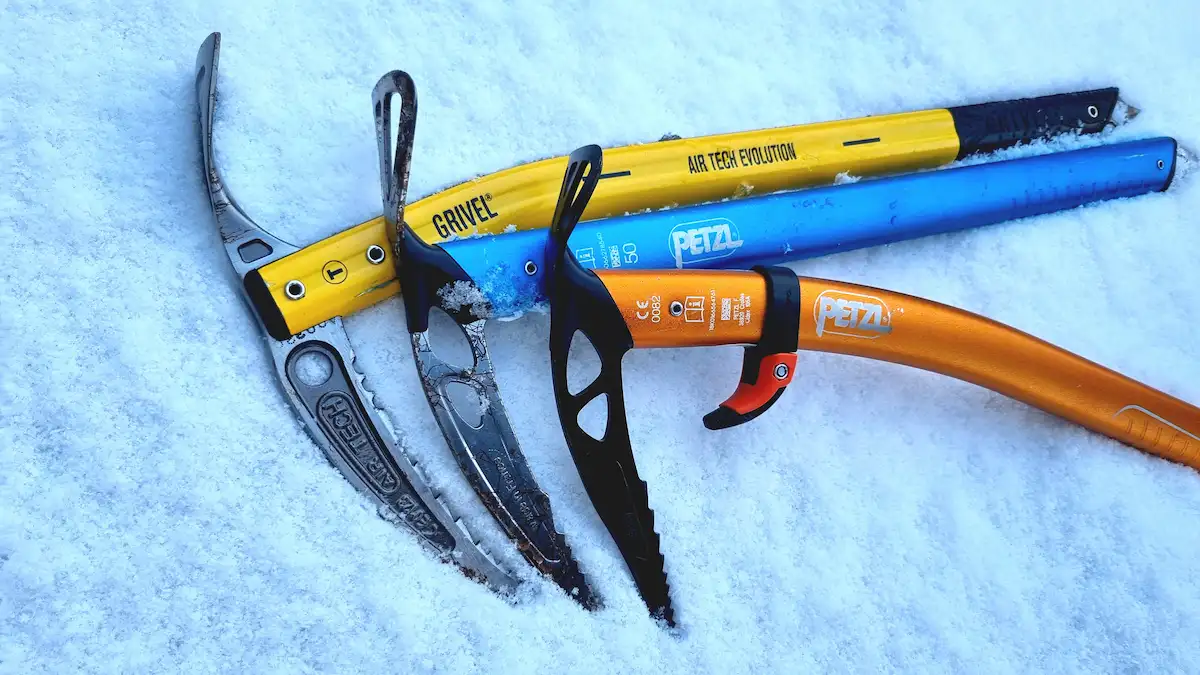
The ice axe is an essential tool in the winter mountains, and this guide will help you with choosing from the many different types.
Winter hikers and climbers wouldn’t dream of going out without without an ice axe. These tools have many different tasks during a journey, but their primary role is to prevent falls down slippery mountainsides. However, correct training and practise are vital. For an overview of some of the best winter mountain hiking in the world, check out Winter hill walking on Britain’s frozen summits. Or read on below to learn more about the different types of ice axe available.
Parts of an ice axe
The hand grip and spike are at the lower end of the aluminium shaft. The top end of the ice axe has a head with a toothed and curved pick. Because we often want to chop and scrape hard snow and ice, the axe head will also have a sharp adze.
Medieval shepherds invented the alpenstock to help them travel through glaciated terrain in the Alps. Aluminium was not in use in those days, so this early type of ice axe had a very long, heavy wooden shaft and an iron tip. In contrast, Hamish McInnes’s 1970s Terrordactyls were among the first short, strong, lightweight aluminium-shafted axes for steep ice climbing.

Types of ice axe
There’s a huge variety of designs on the market, and choosing an appropriate ice axe for your purposes can be hard. So here is a brief rundown of the main types and their features.
⚠️ Always check the proper safety certification is present when choosing an ice axe. An example of this in Europe is the appropriate CE or UIAA mark.
Walking axe
Walking axes are among the longest axes you can buy. This makes them great as ‘walking sticks’, and helps with cutting steps on gentle terrain. Their gently-curved pick works well on easy to moderate snow slopes, therefore making this type of axe well suited for for winter walking novices. They also work well for long and/or high-altitude walking expeditions.


What type of axe for hiking and walking?
A relatively inexpensive and simple ‘walking axe’ is sufficient for hiking. Traditionally, the correct length is when the spike reaches to near your ankle when held at your side with a straight arm.
Mountaineering axe
A mountaineering axe is a more technical version of a walking axe. Mountaineers prefer a slightly shorter ice axe, because it is slightly easier to use on steep terrain. The ‘alpine curve’ pick is more pronounced to give better hold when daggering or swinging into hard snow. Some also have a slightly curved shaft, to help pick placement over snow bulges and edges. Many designs also have a stronger ‘T-rated’ shaft for use in belays (see below).
Furthermore, the head itself may be stronger and more comfortable to hold due to one-piece forging (ie: no weld seams at the adze). Mountaineering axes usually have a lightweight rubber hand grip to save weight.

Ski mountaineering axe
Because low weight is the main design priority for ski mountaineering axes, their minimalist shaft is short and usually only ‘B’ rated. They also lack a rubber grip may only have an aluminium spike. The design of this type of ice axe is mainly for self arrest and basic mountaineering.

Technical climbing axe
Climbers use a pair of relatively heavy ‘ice tools’ to climb steep ice and mixed routes. Usually, they will want to fit one axe with an adze and the other with a hammer, to help place and remove protection. Therefore, they will choose an axe with a modular head. The T-rated shafts of this type of axe tend to be short and highly curved, with ‘reverse curve’ picks to provide maximum security on steep routes.

Picks designed specifically for brittle water ice are especially thin (and thus not T-rated). Some climbers still use leashes for support when pulling on the axe. However, many modern climbing axes now have substantial hand and finger grips, enabling leashless climbing. Some designs also allow small weights to be added to the head to give a more powerful swing.
⚠️ Strength ratings are important if you are intending to bury the axe to use as an anchor when belaying. You will need an axe with a ‘T rated’ shaft for this (T meaning ‘technical’). General-purpose walking axes, on the other hand, are almost always ‘B rated’ (B meaning ‘basic’). This type is not recommended for axe anchors. T-rated picks are slightly thicker and designed for torquing in rock cracks.

Choosing an ice axe
To choose an ice axe, you will first need a clear idea of what terrain you will mostly be on. For example, if you are into steep mountaineering, a long walking axe is not the best idea. Try several in the hand if possible: the head and grip of some are more comfortable to hold than others. The exact length and shape of the shaft and pick will also help you decide.
| Walking | Mountaineering | Ski mountaineering | Climbing |
|---|---|---|---|
| Welded steel head | One piece forged AL / steel head | Welded steel / AL head | Modular AL head with adze/ hammer. |
| Steel pick with a gentle curve. | Steel pick with an ‘alpine’ curve. | Steel or AL pick with an alpine / reverse curve. | Steel pick with a reverse curve (T-rated or water-ice type). |
| Long, straight B-rated AL shaft. | Medium length straight / curved, T-rated AL shaft. | Short, straight / curved B-rated AL shaft. | Short, curved, T-rated AL / carbon fibre shaft. |
| Minimal / no grip with a basic leash. | Light weight grip with basic leash. | Minimal / no grip | Substantial grip with technical leash / leashless. |
| Steel spike | Steel spike | Steel / AL spike | Steel spike |
| Used singly. Light weight. | Used singly. Light weight. | Used singly. Very light weight. | Used in pairs. Heavy. |
Ice axe self arrest
If you fall and start sliding down a snowy or icy slope, you can build up speed extremely rapidly. If not stopped quickly, this could result in severe injury, or even death. By scraping the ice axe pick in the snow surface, we can gain control and soon stop a slide. This manouver is called ‘self arrest’ and it is a vital winter mountaineering skill. It is often taught on winter skills courses and requires professional training to learn properly.

How do you use an ice axe?
How to use an ice axe when walking
- Hold your ice axe by the head
The shaft should hang vertically, with the spike pointing down.
- Axe in your uphill hand
Most of the time, your axe should be in your uphill hand (unless cutting steps in descent). You will probably need to swap hands to achieve this.
- Pick pointing forwards or backwards
Forwards-pointing orientation is commonly taught in Europe. Backwards-pointing is often taught in Britain. Both have their advantages.
- Use your axe for support
Your axe can act as a walking stick on slippery or steep terrain. Many other ice axe techniques exist, which should be trained by a professional (eg: step cutting, daggering, climbing).
- Be ready to self belay or self arrest
Self belay is a technique to stop a slip becoming a slide. Self arrest is an emergency drill to stop yourself when sliding. Both must be professionally trained.
The ice axe is an absolutely essential tool for winter walkers, climbers and ski mountaineers. With it, you can cut steps, check the snowpack, dig a shelter, cut blocks and prevent falls. Despite their simple appearance, modern axes are very varied and specialised, requiring professional training to use properly. The ice axe should be near the very top of your winter walking kit list.

Ice axes, crampons and famous scenery
