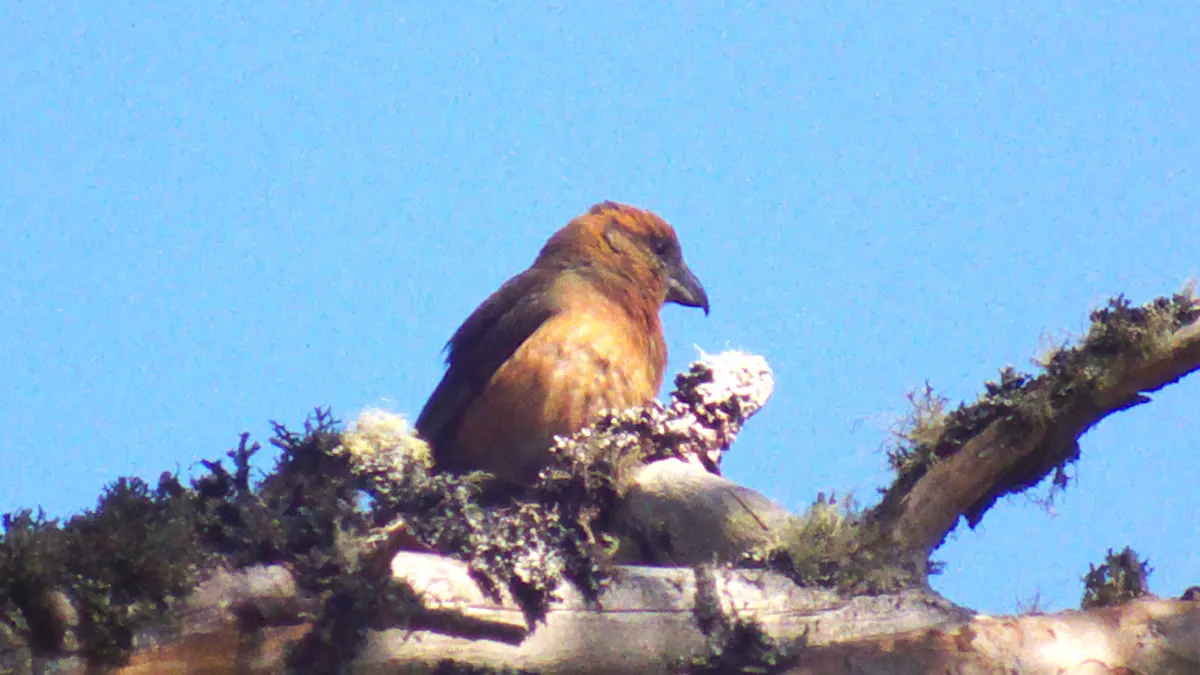
Crossbills are fascinating birds – especially when you’re looking for common, parrot, or legendary ‘Scotbills’ in the Highlands of Scotland!
These big, highly specialised finches can be hard to find at the best of times. But when you realise that there’s more than just one species involved, things become a bit more complicated. To learn more about these fascinating birds, and about the status of the ‘Scottish crossbill’, read on. For an overview, see the post Wildlife in Scotland: A Beginner’s Guide.
Go to
Crossbill biology

Species factfile ❀
Common name: Scottish crossbill Scientific name: Loxia scotica Order: Passeriformes, Family: Fringillidae Measurements: 15.5-17cm long, weight 40g Habitat: Old Scots pine forests and mixed commercial conifer plantations Range: Scottish Highlands Conservation status: Wildlife and Countryside Act 1981: Schedule 1 species, UK Birds of Conservation Concern: Red listed, UK Biodiversity Action Plan Species
Crossbills are large, sociable birds with powerful bills, used for cracking open pinecones. Their neck and heads are bulky and muscular. Males are brick red on the body, whereas female crossbills are green. Juveniles are streaky grey-brown in colour. They often fly in groups numbering from one or two, to dozens of individuals.
Being finches, crossbills are usually quite vocal and you will probably hear them before you see them. When feeding, they tend to make soft, quiet ‘chup, chup’ contact calls, with ‘pitchoo, pitchoo’ calls mixed in. ‘Chip chip or ‘chup chup’ contact calls tend to be given when in flight. During the breeding season, the males also produce ‘toy trumpet’-like hoots and a distinctive song made up of soft tinkling notes and chirps.
Crossbill feeding behaviour
Crossbills are specialist feeders on the cones of conifer trees (eg: pine, larch, spruce, fir). They will also eat seeds from, for example, birdfeeders and thistles, but this is when their preferred food is unavailable. Crossbills can be found by the distinctively ‘worked’ pine cones they leave behind.

The birds prise apart each scale in order to extract a pine seed from between them, but they need to time it right. Too early and the cones will be very tough and the seeds undeveloped. Too late and the cone will have opened and the seeds blown away. The timing of the cone crop itself can also be an issue. Many conifers go through cycles of high and low productivity, and when the population of crossbills outstrips their food source in one region, they may move en masse to another area. Over the years, Britain has experienced a number of so-called irruptions, where thousands of birds have arrived from Scandinavia.
Crossbills name comes from their crossed-over bill tips (unsurprisingly). The genus name ‘Loxia’ comes from Ancient Greek, meaning ‘crossed’. ‘Cam ghob’ is their name in Gaelic, which translates as ‘squint beak’.
Where to find crossbills in the Highlands of Scotland
The map below shows a selection of good areas to look for crossbills in northern Scotland. The resident population of parrot crossbills occurs in old Scots pine forest in the RSPB Abernethy reserve, near Nethy Bridge. Common crossbills, on the other hand, can occur in pine, larch and spruce forest throughout the UK.
Breeding
Amongst Scottish birds, crossbills are one of the earliest breeders, with courtship beginning as early as February. Their nest is a deep cup made of twigs, grasses and lichen. It is lined with moss and wool and often located high up in the canopy of a pine tree. The parents tend not to be as vocal when nesting, which avoids drawing attention to the nest. This likely reduces the risk of predation by red squirrels and pine martens. Incubation is 13-15 days.and the average number of young per nest is 3-4.
Nesting very early in the season may help crossbills exploit an unpredictable pine cone crop. But it does mean chicks must face very cold, wet, windy weather. This is where we see another fascinating adaptation: nestling torpor. Between feeds, the chicks heart rate, breathing and temperature all drop, thus conserving energy in adverse weather.
Parent crossbills feed their young a nutritious ‘porridge’ made of semi-digested pine cone seeds. When the young fledge, they join the adults in noisy mixed flocks. This provides the fledglings protection from predators, but also feeding opportunities. The latter is especially important because of the long time it takes for their beaks and feeding skills to develop.

How to find crossbills
How to find crossbills.
- Begin looking in early spring
These early breeders may be displaying and nest building as early as February.
- Walk slowly in conifer forests
The idea is to maximise time in the correct habitat. When guiding clients in the Cairngorms National Park, I head for areas of old Caledonian pine forest for a chance of Parrot crossbill. In Britain, it’s also worth visiting areas of pine, spruce, fir and larch plantation, which are also used by common crossbill.
- Get familiar with their calls
See text above for a description of their calls. An app such as Merlin may also be useful.
- Go out in calm weather
Windy conditions make listening (let alone watching) much more difficult.
- Select wide, open viewpoints
Keep an eye on the treetops, this where they will be looking for cones.
- Take a telescope
These birds are rarely close, so a scope makes a big difference.
- Watch out for pinecone debris
‘Worked’ cones on the ground can be a helpful sign of crossbill activity.
Although crossbills appear similar, there are subtle differences between species. When I am guiding, I mainly look for a good view of their beak, because it’s size and shape can be diagnostic. But this is difficult because these flightly birds spend a lot of time in remote areas, at the top of conifer trees!

Cairngorms Wildlife Day Tour (1 day)
Expert-led wildlife and birding day tours exploring the special habitats in the Cairngorms (Aviemore and local area, private booking available)

Common and not-so-common crossbills in Scotland
It was originally believed that there was only one species of crossbill breeding throughout Britain: the relatively small-billed ‘common’ (L. curvirostra). However, some birds observed in northeast Scotland showed noticeably large bills. These ‘Parrot’ crossbills (L. pytopsittacus), with their distinctive huge beaks, were known to arrive from Scandinavia during irruption years. Was hybridisation the cause? It was thought not because the migrant ‘parrots’ arrived infrequently and in very small numbers.
But in the 90’s a very small, isolated breeding population of parrot crossbills was discovered in Abernethy forest in the Cairngorms. With the discovery of this resident population nearby, the identity of intermediate-sized crossbills in the Scottish Highlands became more complex. Were they parrot, common, a hybrid, or another species altogether?

A crossbill unique to Scotland?
A research project in 20011 found surprisingly few genetic differences between the three forms. This led to doubt over whether Scottish crossbills were in fact a true species. So in 2007, scientists in Scotland carried out an extremely detailed study of all aspects of wild and captive crossbills. The conclusion? Common, Scottish and parrot crossbills mostly behaved as seperate species, but with a small amount of interbreeding2.
This strengthened the case for Scottish crossbill being an endemic bird species and therefore a conservation priority. Experts decided that sonograms of the bird calls were the only conclusive way to identify this bird.
However, in 2022 a re-analysis of sonogram data suggested that, actually, this was not as reliable a method as was first thought. Thus, the current position is that reliable identification of ‘Scottish crossbill’ in the field is impossible.
‘Because of this current uncertainty [about specific Scottish crossbill calls] SBRC is no longer aware of any plumage, biometric, vocal or genetic criteria that can be used to identify Scottish Crossbill with confidence. As a result, SBRC will no longer consider any records of the species’
The Scottish Bird Records Committee3
So it can be seen that finding any crossbill species is a difficult task, let alone finding Scottish crossbills. Their biology and habits are fascinating, being highly adapted to live off a diet of conifer seeds. All this together makes them one of the most rewarding forest birds to find.

Spring birding in the Cairngorms and more

References