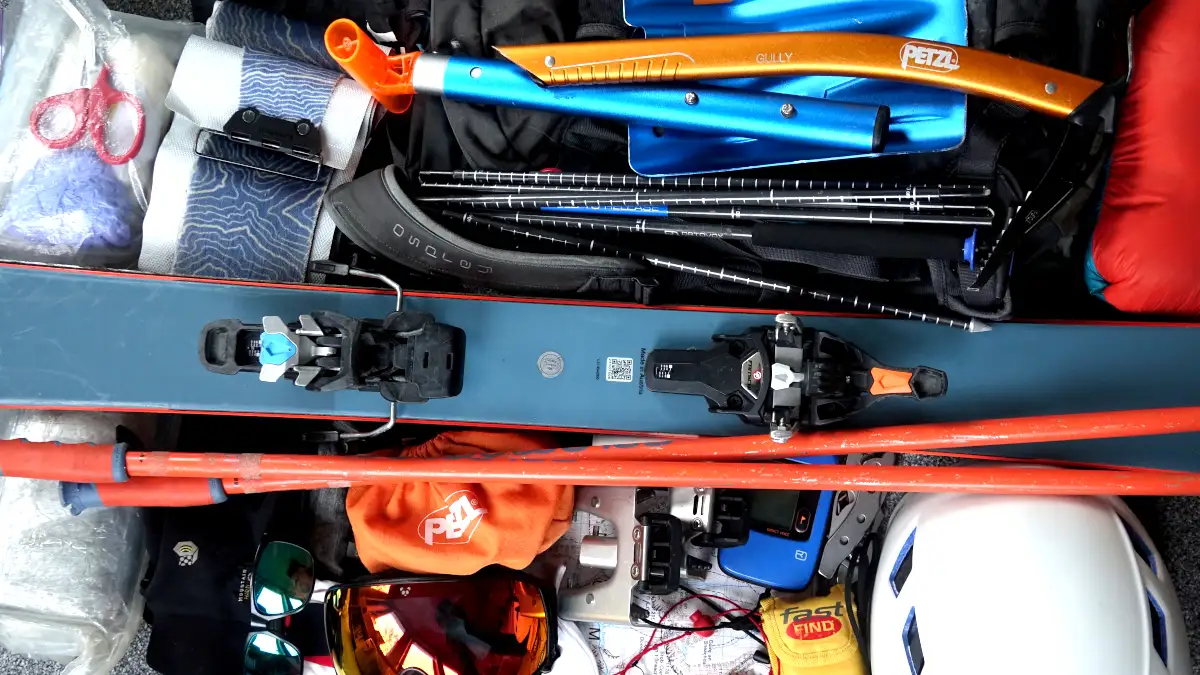
Kit list for ski touring, with tips on gear to pack for different backcountry missions.
Personal gear
- Helmet (H)
- Rucksack (30-40 litres)
- Ice axe (H)
- Boot crampons (H)
- Drybag/plastic bag
- Food and drink
- Spare warm layers or belay jacket
- Spare mountaineering gloves
- Hat
- Goggles or sunglasses
- Watch (ideally with an altimeter)
- Phone
- Headtorch
- Spare goggles or sunglasses
- Map, compass
- Sunscreen
- Lipsalve
- Any personal medication
- Long ski tie or strap
- GPS (L)
- Multitool (L)
- Insurance documents (not UK)
Backcountry ski gear
- Ski/trekking poles (H)
- Ski crampons (H)
- Climbing skins (H)
- Touring skis or splitboard (H)
Emergency gear
- Avalanche probe (H)
- Avalanche shovel (H)
- Avalanche transceiver (H)
- Satellite messenger/PLB (L)
- Whistle
- Group shelter (L)
- Confidence rope (L)
- HMS karabiner and sling (L)
- Survival bag
- Small first aid kit
- Small spares/repair kit (L)
(H) Hire locally, (L) Group leader, Not all items always needed!
Gear list and packing tips for backcountry ski touring
Firstly, a good back pack is one of the best investments you can make for backcountry ski touring. It should have side compression straps and/or a diagonal/vertical ski/board carry facility. Next, an ice axe is important safety tool (although one per group may be enough in benign terrain). Spare mountaineering/ski gloves are also vital. Ski crampons can be essential in some situations, but check beforehand. A long rubber ski tie (eg: from Black Diamond) can be very useful and relatively inexpensive. To stay properly hydrated, you will need about 2 litres of fluid – any more than that and your pack can become too heavy. Finally, take a first aid kit capable of treating not just blisters but also more serious mountain injuries.
Skis, boots and poles
Unless you are using a splitboard, your skis must be fitted with touring bindings which must also be compatible with your boots. Remember to pack your climbing skins (tip: fit them to your skis in advance if the weather is really bad). Your backcountry ski poles should have wide baskets to avoid sinking in unpisted snow.
A heavy pack spoils the skiing,
so use lightweight, multipurpose touring gear where possible 👌
Avalanche kit
Avalanches in Scotland are a thing, so don’t forget your transceiver; but you’re better off wearing it from the start, rather than packing it in your rucksack! If you are packing a transceiver, you should also have an avalanche probe and shovel too.
Also see:

Are you a guest on an Arc Guiding trip?
Check with the guide when deciding what to wear/pack. Choose items from the list depending on weather, route and aims.
Hut-to-hut ski touring
Your overnight kit will depend on the hut facilities. You may also need food, cash, credit card, club membership card and perhaps a book, playing cards and headphones.
Technical ski mountaineering
You will need to choose the right type, length and thickness of rope for the terrain, with compatible prussiks, ascenders, pulleys and karabiners as needed. Your gear list for this type of ski touring should also include slings and a harness.
Backcountry ski gear list FAQ
As well as skis, poles and skins, you will also need personal mountain clothing and equipment. An avalanche transceiver, probe and shovel is standard, plus ski and/or boot crampons in some situations.
Some modern ‘downhill’ boots are compatible with some touring bindings, but it depends on the model and condition. Although a frame-type touring binding will take almost any ski boot, older style downhill boots are not very safe, or comfortable for hiking or mountaineering.
For ski touring in non-glacier terrain, a harness is not needed. However, harnesses are needed for glacier travel, mountaineering and potentially couloir skiing.
Firstly, a waterproof shell layer and a synthetic belay jacket are essential. Secondly, spare gloves. Next good navigation kit (including goggles), small repair kit, ice axe, boot or ski crampons and a headtorch.
Selecting backcountry ski gear is tricky. Choose items depending on the weather, route and aims of the trip and get expert advice before you set off.
Rubber ski straps are very useful for carrying skis and also for improvised repairs.
A 30-40 litre capacity rucksack is ideal for ski touring (for instance, from Osprey). It should also be able to carry skis either vertically, on the sides, or diagonally.
Avalanche airbags are very effective, but their weight and cost makes them less popular for short descents (for example, in Scotland).

Build backcountry skills and experience
