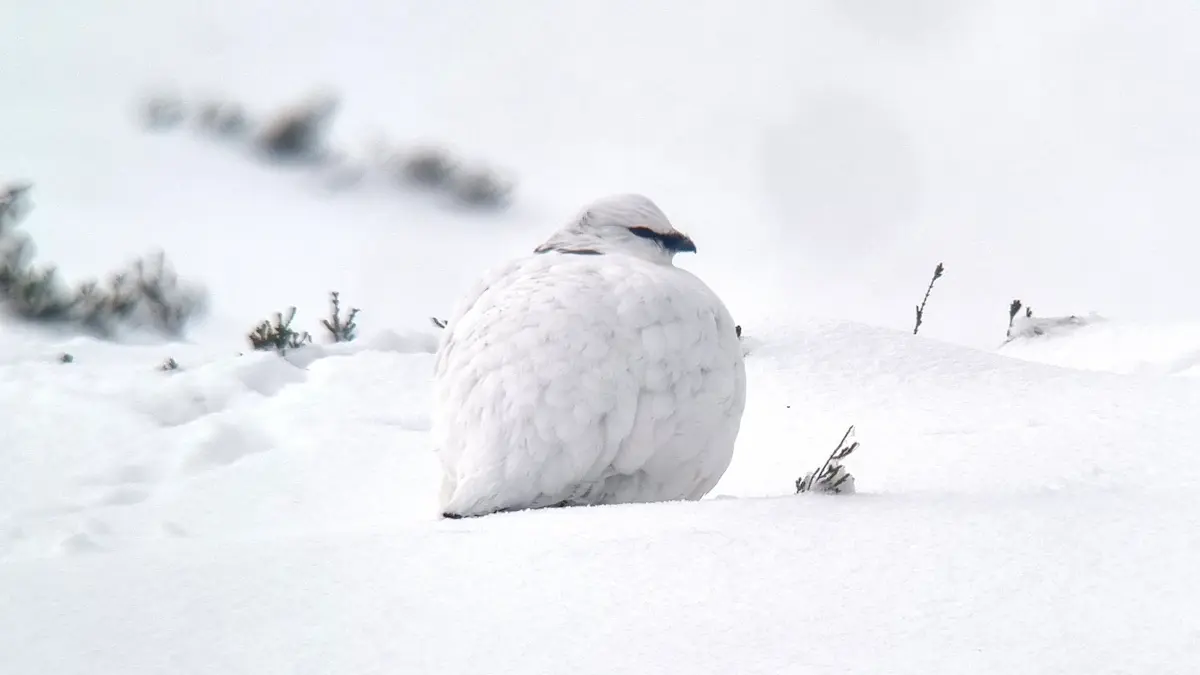
Learn about the hardy ptarmigan and get tips on how to spot them in the Cairngorms in Scotland.
Many birders would consider ptarmigan to be a key Scottish wildlife species. Unfortunately, this bird’s Scottish population is facing growing pressure from climate change. Read on to learn more about the fascinating mountain ‘murmurer’. To learn more about our wonderful flora and fauna, read our post: Wildlife in Scotland: A Beginner’s Guide.
Habitat
Ptarmigan live in the mountains, a habitat they share with other arctic-adapted birds such as snow bunting. In Scotland, they usually occur above about 800m, moving up and down the mountain in response to weather and food availability. Many British birders choose to visit the Cairngorms in the hope of spotting ptarmigan (see Birdwatching near Aviemore and the Northern Cairngorms for more info). These are one of the toughest Scottish birds, thriving in temperatures as low as -20C, together with storm force winds.


Species factfile ❀
Common name: Ptarmigan Scientific name: Lagopus muta Order: Galliformes, Family: Tetraonidae Measurements: Length up to 36cm, wingspan up to 60cm, weight 400-600g Habitat: High mountains and montane regions Range: Arctic and subarctic regions and high mountain terrain in Europe, Russia, Asia and North America. Conservation status: UK Birds of Conservation Concern: Red listed
Name
Their name comes from the Scottish Gaelic meaning ‘murmurer’, in reference to their grumbling-like call. Their Latin name, Lagopus, comes from Ancient Greek meaning the ‘foot of a hare’. Muta comes from Latin meaning ‘without a voice’.

Identification
Ptarmigan are small members of the grouse family. They are famous for their effective and beautiful camouflage. During winter, both sexes are pure white, apart from black tails and, in the male, a black eye stripe. During summer, males are generally mottled grey and females more brownish. This camouflage gives them protection from predators such as golden eagles and peregrine falcons. It also hides them from foxes, ravens and stoats, which would steal their eggs.
In Greenland ptarmigan are still an important food source and are hunted with rifles. However, their Greenlandic name Aqisseq gives a clue as to how they were hunted in the past. It refers to being ‘caught in a noose on a pole’ (incidentally, the same technique used by the guga Gannet hunters on the Western Isles of Scotland).

Males also have a small red wattle above the eye which becomes more obvious during courtship. In flight during spring, their white wings contrast sharply with their camouflaged body. Males have a black eye stripe and black outer tail edges at all times of year. Ptarmigan most frequently make a gutteral croaking-like call. This often seems to work as both a contact and alarm call.

How to spot ptarmigan
Ptarmigan are masters of arctic camouflage. To find them, you should therefore be prepared to spend a fair bit of time in a potentially hostile environment. That means plenty of warm clothing, good hillwalking gear and decent optics. Scan through boulderfields and short grass and heather, watching for movement. Also, listen for their distinctive call. Remember to avoid disturbing them, however.
⚠️ The Cairngorms are a popular location in which to try to spot ptarmigan. Remember, though, that this is a UK Red-list bird, facing a serious population decline. Therefore, avoid flushing them, or disturbing nests or parents with dependant young.

Cairngorms Wildlife Day Tour (1 day)
Expert-led wildlife and birding day tours exploring the special habitats in the Cairngorms (Aviemore and local area, private booking available)
Adaptations of Ptarmigan
Ptarmigan have many adaptations for surviving in arctic habitats. For example, they moult and regrow their feathers 3 times a year to maintain camouflage. Feathers on the body offer excellent insulation against hurricane-force winds and windchill down to around -30 C. Meanwhile, feathers on the feet prevent sinking in snow and help with digging for food and shelter.
In addition, their short, stiff and curved wings (typical of grouse) enable very powerful takeoff and acceleration, which helps them to escape predators.


Feeding
During winter, these birds will often scrape down through snow using their clawed feet. This provides shelter, and also enables them to reach food. Their food includes young heather shoots and seeds and berries (eg: crowberry, cloudberry, bearberry). Chicks, on the other hand, feed on spiders and insects.
Breeding behaviour
Pairs bond for the season, producing one brood of up to 7 eggs. They nest on the ground between early May and early June and incubate for 22-23 days. The hen and chicks abandon the nest within about 24 hours of hatching.

Ptarmigan in Scotland
Almost all of Britain’s ptarmigan are found in the Scottish Highlands, from about 800m upwards. However, as climate change affects their habitat, the highest summits (Ben Macdui, Cairn Gorm and Ben Nevis for example) will increasingly become important refuges for this species.
Interestingly, there are a few locations where ptarmigan exist at lower altitudes, for example, Cape Wrath. Here suitable habitat exists due to extreme local weather conditions. They are also present on the islands of Skye, Mull, Jura and Arran.
Unfortunately, the ptarmigan population in Scotland has dropped 81% since 1961. As a result, this previously Green-list species is now on the UK Red list.
Conservation
Although the IUCN Red List classifies them globally as ‘Least Concern’, the British population only lives in our highest mountains. Here, their habitat is likely to shrink due to climate change. Increased pressure from predators and mountain users is a subsequent possibility. Although collisions with ski infrastructure do occassionally happen, they are rare.

So, the ptarmigan is a master of camouflage and arctic survival, but is in serious decline in Scotland due to climate change. Hopefully, disturbance and predation in their mountain-top habitat will be kept to a minimum, so we can enjoy hearing (if not seeing) them in the futue.
Ptarmigan FAQs
These are birds which live in mountain terrain across the Arctic and subarctic. They are famous for their camouflage, achieved by dramatic seasonal colour changes.
The plumage of the Ptarmigan (Lagopus mutus) changes colour according to hormone levels, particularly melatonin, in the blood. The production of these hormones is influenced largely by day length.
Although Ptarmigan have been added to the UK Red List, they are not a Schedule 1 species under the Wildlife and Countryside Act. Therefore, they remain a legal gamebird (‘quarry species’) in Scotland. They cannot be shot during the close season, 11 December to 11 August.
Ptarmigan occur in many mountain areas in the Scottish Highlands above about 800m. The Cairngorms mountains are one of the most popular areas for viewing this species.

Spring birding in the Cairngorms and more
