Learn about the past, present and future wild mammals of Scotland (and check out the detailed Scottish Mammals species list at the end of this post).
Wild mammals are some of the most recognisable, important and looked-for wildlife species in Scotland. They have attracted both fame and persecution over many centuries, despite making up a tiny fraction of Scottish wildlife. In this post, we will look in more detail at this small, but very important group of animals.
Go to:
- The mixed fortunes of Scotland’s mammals
- Hedgehogs and other insectivores
- Bats: Scotland’s night-flying mammals
- Scotland’s mammal carnivores: weasels, grey seals and more
- Deer and other ungulates
- Scotland’s marine mammals: whales and dolphins
- Red squirrels, water vole and other rodents
- Mountain hare and brown hare
The mixed fortunes of Scotland’s mammals
Less than 0.1% of Scotland’s wildlife species are mammals. However, they are some of the most famous in the UK, for example red deer and bottlenose dolphin. Wild mammals have colonised almost all habitats in Scotland, ranging from the high mountains to dense forests and from tiny burns to and open sea.
However, some species are absent from certain Scottish islands (there are no foxes on Orkney, for example), whilst others were hunted to extinction centuries ago. Some non-native mammal species have been introduced from overseas, causing problems for both wildlife and humans. On the other hand, Scotland is home to around 30% of the world’s grey seals and most (if not all) of Britain’s wildcats, pine martens, red squirrels otters and mountain hares. Indeed, many of Scotlands native mammals are now legally protected.
So, the story of mammals in Scotland is a complicated one! To try to help understand it better, let’s get an introduction to the eight main groups of mammals in Scotland.

Hedgehogs and other insectivores
The shrews, hedgehog and mole include some of the smallest of Scotlands mammal species, all of which have pointed teeth for feeding on insects. However, they also eat a wide variety of other prey, including earthworms, slugs, snails, carrion and birds eggs.
In a few cases, these animals take prey as large as themselves, such as fish or baby birds. In fact, hedgehogs were removed from parts of the Western Isles because they predated the eggs and chicks of ground nesting birds.The shrews are a remarkable family. To illustrate, the pygmy shrew is one of the smallest mammals in the world, at only 4g in weight. Furthermore, the water shrew is one of the only mammals in the world to have a venomous bite.

Bats: Scotland’s night-flying mammals
Bats are actually one of the more diverse groups of mammals in Scotland, with 9 recorded species (over half the British total of bat species). Britain’s bats all use echolocation for hunting and navigation (Suborder Microchiroptera).
All of Scotland’s bat species are in the same family and share the same two characteristics. Firstly, they have a pointed or curved membrane between the hind legs. And secondly, they all echolocate through the mouth (other bat families echolocate through the nose). The most commonly seen bats in the Scottish Highlands are common pipistrelle, Daubenton’s bat and brown long-eared bat.

Scotland’s mammal carnivores: weasels, grey seals and more
Scotland has many mammals which are wholly or partly carnivorous. However, the closely related families in this section are in their own sub-group: the ‘Carnivorans’. Many carnivorans compete directly with humans for food, which unfortunately has led to the extinction of Britain’s large land predators.

Biologists divide carnivorans into two broad groups. Firstly the ‘Cat-like’ carnivorans (Suborder Feliformia), comprising the Scottish wildcat and Eurasian lynx. The latter was in Scotland from at least 1700 years ago (evidenced by bones recovered from Inchnadamph in northern Scotland). However, humans hunted them to extinction in Scotland during the 17th Century.

Pine marten in Scotland
Pine martens were nearly extinct in Britain by the 1990’s, with only a few relic populations in the Highlands and North Wales. However, the Scottish pinemarten population is booming now, and reintroductions are happening in England. They perform an important role as ‘mesopredators’ in the environment, and may actually help red squirrels by predating grey squirrels.
Secondly, the ‘Dog-like’ carnivorans (Suborder Caniformia). This broad group contains several native mammal species still living in Scotland, including the otter, badger and pinemarten, fox and grey seal and common seal. Several other species are now extinct in Scotland. Specifically, prehistoric hunters and habitat loss eliminated the wolverine and arctic fox, Iron Age hunters removed all the brown bears and 18th Century hunters finished off the grey wolves.
Two non-native carnivorans breed in Scotland and cause problems for native wildlife. Firstly, the American mink, which has decimated the water vole population. Secondly, feral cats which unfortunately hybridise with native Scottish wildcats.
These two non-native mammals were introduced by humans, but others sometimes arrive in Scotland naturally. Two spectacular examples of this are walrus and bearded seal from the Arctic (these qualify as vagrants because they do not stay and breed).
Were polar bears ever in Scotland? Scotland is at approximately the same latitude as Hudson Bay in Canada. Here, polar bears regularly gather in large numbers, so this is not an unreasonable question. The answer is yes, they were present in Scotland during the last Ice Age, inferred from the recovery of ancient polar bear bones at Inchnadamph. Moreover, large white fur-like masses occassionally wash ashore in northern Scotland. People sometimes identify these as polar bear remains that have floated down from the Arctic. However, these are actually decomposing blubber from whale carcasses – called ‘globsters’.

Cairngorms Wildlife Day Tour (1 day)
Expert-led wildlife and birding day tours exploring the special habitats in the Cairngorms (Aviemore and local area, private booking available)
Deer and other ungulates

Scotland is home to several species of ungulate mammals. These are the deer, cattle, goats, sheep and pigs, which all possess hooves with an even number of toes and multi-chambered stomachs. Interestingly, the whales and dolphins are close relatives.
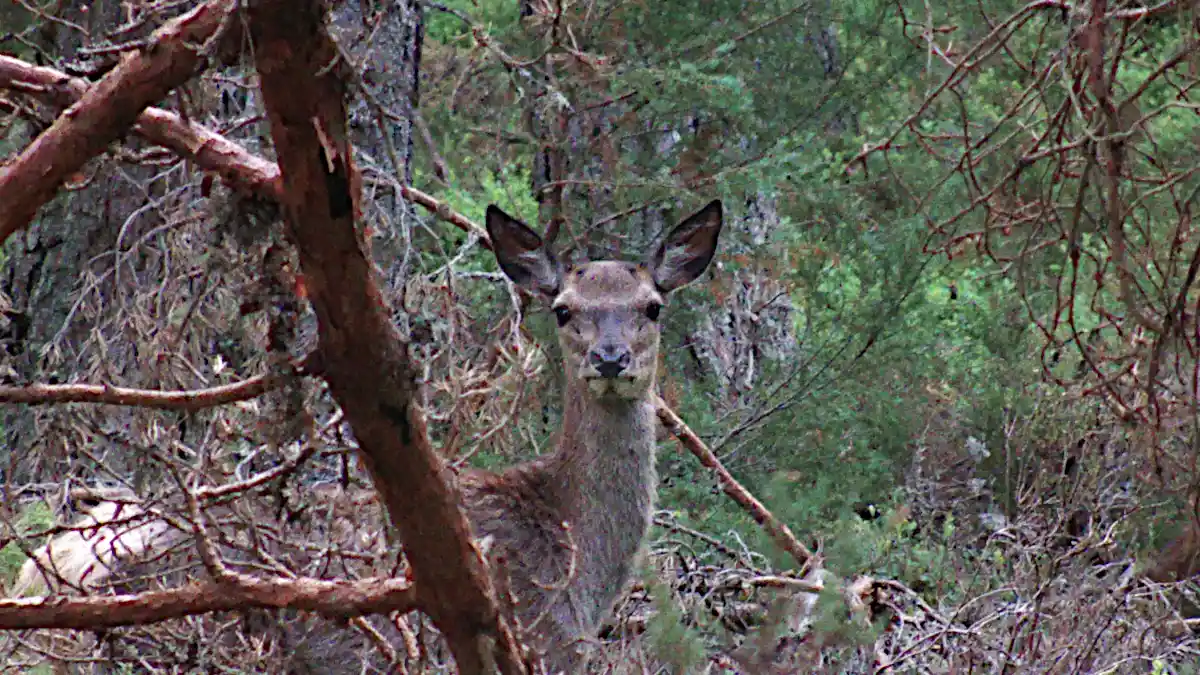
Four living species of deer are native to Scotland, although Neolithic hunters extirpated one (the moose-like Eurasian elk). One of the four, reindeer, was absent since the last ice age until a Norwegian visitor reintroduced them to the Cairngorms in the 1950’s. The remaining two, red and roe deer, are plentiful due to lack of predators (and therefore culled). Unfortunately, some reds hybridise with a non-native deer – the sika. Hunters introduced these from Asia during Victorian times. Finally, the Romans introduced the fallow deer to Britain. But these deer established themselves in only a few places in Scotland.
Native Scots pine forest habitat is slowly recovering thanks to careful reduction of red deer numbers within the Cairngorms Connect landscape.

Aurochs
The wild aurochs was the ancestor of domestic cattle breeds. These large ungulates were extinct in Scotland by the Bronze age and globally extinct by the 17th Century. However, modern Highland cows (and Torus cattle) can perform a similar ecological role to the ancient wild aurochs. Thus some land managers use them in rewilding and regenerative farming. Steppe bison were present in Scotland during Mesolithic times, but they are now globally extinct. Although not native, the similar European bison may be a candidate for future introductions in Scotland (as with the Wilder Blean project in England). In both these cases they improve habitats through a process called ‘conservation grazing’.
Feral goats frequent some parts of the Scottish Highlands. Late Stone Age settlers almost certainly brought these animals into the country, whereas true ‘wild goats’ live in the Mediterranean. Similarly, domestic sheep first arrived in Britain about 5000 years ago. These animals originated from the still-living wild urial (Ovis orientalis). Medieval hunters finished off Scotland’s wild boar. Nevertheless, our domestic pig breeds originate from wild boar and feral boars now occur in a few parts of the Highlands.
The horse family comprises all the ungulates with an odd number of toes. These species walk on their third toe (which usually has a large hoof), or on three toes. Although living wild, the Shetland and Eriskay ponies are in fact non-native feral animals introduced by Celtic and Norse settlers respectively. There was a true ‘wild horse’ – the tarpan, which lived in Scotland. However, it became extinct in Scotland probably during the Neolithic era, and globally extinct by the 19th Century.
Interestingly, one extinct member of this group that was native to Scotland was the woolly rhinoceros!
Scotland’s marine mammals: whales and dolphins

The seas around Scotland are home to some of the largest (and most intelligent) wild mammals on Earth. Although whales and dolphins are very highly adapted for aquatic life, they are actually closely related to deer and cattle. And, like bats, they also echolocate. They are divided into two subgroups: the Baleen whales (Parvorder Mysticeti) and Toothed whales (Parvorder Odonticeti).
Minke, Humpback and other whales
The baleen whales all filter krill and small fish through hair-like ‘baleen plates’ inside their mouths. Minke whale is the most common baleen whale in Scottish waters, but humpback and fin whales are now being seen regularly. Although all the baleen whales on the Scottish list have been observed in Scottish waters, only a few are known to breed here, or are regularly observed with dependant young.
Dolphins: Bottlenose, common, porpoise and more
Being ‘toothed whales’, all the dolphins and porpoises have simple, pointed teeth for catching squid and fish (and in some cases, other cetaceans). Harbour porpoise, common dolphin, white-beaked dolphin and Rissos dolphin are often seen during the summer. A well-studied population of over 200 bottlenose dolphins lives in northeast Scotland, including the Moray Firth. In addition, an important population of orca (aka ‘killer whale’) lives along the north coast of Scotland. Our larger toothed whales include northern bottlenose and sperm whale, both being seen most years.
Killer whale (Orca) in Scotland
There are 8 in the West Coast Community (4 male, 4 female), including approx 30-year-old John Coe and another male called Aquarius. Sadly, this community is now considered ‘functionally extinct’ due to age and lack of calves, possibly caused by pollution. The Northern Isles Community, on the other hand, consists of 3 pods which between them have birthed 12 calves since 2014.
There are a few very rare sightings of other toothed whales, for example beluga (Delphinapterus leucas).

Whale and dolphin watching in Scotland
Whale and dolphin watching has become very popular in various parts of Scotland, with impressive sightings recorded annually. Boat operators must abide by strict codes of conduct, as all cetaceans are legally protected under UK law.
Red squirrels, water vole and other rodents

Next, we have the rodents, which make up the majority (about 40%) of all global mammal species. Their distinctive large, sharp, continually-growing incisors are key adaptations to help them deal with tough plant material.
In Scotland, we have seven native species, including the famous red squirrel. This species is under threat, however, from another rodent introduced by the Victorians, the American grey squirrel. Similarly, our native water voles have been decimated by the introduction of American mink. Norse settlers introduced the Orkney vole, which is now considered unique and is much-loved. In contrast, the numerous black rats which arrived on medieval ships are now a major predator of puffin eggs and so are extremely unwelcome. Human hunters eliminated all Scotland’s beavers by the 16th Century. But in a change of fortune for these native rodents, they have been reintroduced and are now spreading quickly.
Mountain hare and brown hare

Lastly, we come to the hares and rabbits, which make up only a small proportion of the list of Scottish mammal species.
At first they might seem to be rodents. However significant differences in their anatomy and teeth make them unique. The mountain hare is one of the most recent Scottish mammals to be granted legal protection. In contrast, the incredibly common rabbit was actually introduced by the Romans.

Prehistoric mammals in Scotland
It is interesting to think about the mammals that lived in ancient Scotland. These species range from types of shrew living alongside Jurassic dinosaurs 200 million years ago, to large extinct Ice-age species such as woolly rhinoceros, sabre-toothed cats, woolly mammoths and the ‘Irish’ giant elk (Megaloceros spp). More well-known mammals that retreated from Scotland in neolithic times include hyenas, lions, arctic lemming and polar bear.
So, we have seen that the diversity of mammals in Scotland is quite broad for such a small country. But centuries of human activity has resulted in the loss of several large native species. In addition, some non-native species now occur, which can cause problems. However, recent mammal reintroductions are at last helping to improve Scotland’s native wildlife biodiversity. See below for FAQs on Scotland’s mammals and a detailed species list. You might also want to check out our Recent wildlife sightings.
References
The History of British Mammals, Yalden (Poyser, 1999)
Field Guide to the Mammals of Britain and Europe, Macdonald & Barrett (Collins, 1993)

Spring birding in the Cairngorms and more

Scotland has about 33 species of land mammals living in the wild (ie: not domesticated). Several more species of bats, whales, dolphins and seals also breed here, or have been recorded.
The largest wild land mammal in Scotland is the red deer, but this is small compared to the largest recorded sea mammal in Scotland: the blue whale.
No, unfortunately, wolves, bears and lynx were exterminated in Scotland during medieval times.
At present, there are no plans to reintroduce wolves to Scotland. It was considered at Alladale estate in northeast Scotland, but abandoned partly due to issues with access rights and habitat.
A native species is one which has arrived and formed a self-sustaining population in an area, without human intervention.