
Waxwings (Bombycilla garrulus) are small migrant birds with a trilling call, sometimes giving spectacular sightings in the UK in winter.
These are, in my opinion, one of THE most exotic-looking wild birds you could see in Britain. For me, they really highlight the diversity, interest and excitement to be found in our wildlife. Read on to learn more about the ‘silky-tailed chatterer’. To learn more about Scottish wildlife, see our post Wildlife in Scotland: A Beginner’s Guide).

Species factfile ❀
Common name: Waxwing Scientific name: Bombycilla garrulus Order: Passeriformes, Family: Bombycillidae Measurements: Length 18-21cm, 51-66g Habitat: Forests, parks and gardens containing berry trees and bushes Range: Scandinavia, northern Russia and Siberia Conservation status: UK Birds of Conservation Concern: Green listed, IUCN Red List: Least Concern
How did they get their name?
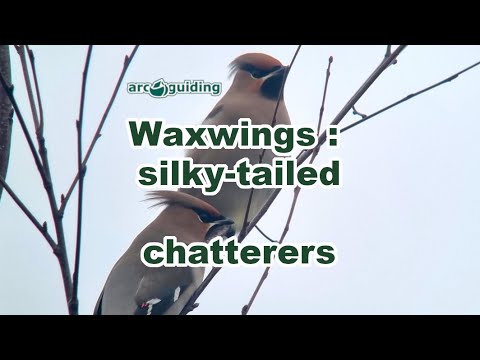
These birds get their common name from their red-tipped wing feathers, resembling little blobs of old-fashioned red candle wax. They are also known as Bohemian Waxwings, on account of their flamboyant appearance and to differentiate them from the Cedar Waxwing of North America. Their scientific name Bombycilla garrulous roughly translates as ‘silky-tailed chatterer’.

Identification and call
This species is similar in size to starlings, with a slightly more plump silhouette. Their body and part of the head is coloured pinkish-buff. They have a dark eye-stripe and thoat patch, together with a large extendable pinkish crest on top of the head. Their yellow and white wing markings and yellow tail stripe make them even more noticeable.
This species is very sociable and they often travel and rest in groups (sometimes of several hundred individuals). Waxwings are quite vocal, making a high-pitched, crystal clear trilling contact call, both in flight and when feeding.
When seen close, small red tips are visible on the secondary flight feathers. These are actually extensions of the tip of each feather shaft. The sexes are very similar, with female and 1st-winter birds having slightly less obvious markings.

Berries are by far the preferred food of this species. I have most often seen them feeding on Rowan berries, but also Cotoneaster and juniper. They will also take other wild berries and even sliced fruit such as apple (see this video of hand-feeding waxwings on Fair Isle). In Scotland, waxwings have also been seen eating insects, tree buds and flowers. Being highly sociable enables waxwings to quickly locate new food sources when faced with challenges such as bad weather, unfamiliar territory or competing thrushes such as redwings and fieldfares.
Waxwing sightings
Perhaps surprisingly for such a conspicuous bird, it can be tricky to get a sighting of waxwings. So here are some tips for finding them. First, the waxwings call is frequent, distinctive and easily heard – which is very helpful for locating them. Second, when they arrive in an area, they will be looking to feed in berry trees, so keep checking these, even in town centres and carparks. Although they tend to be flighty and nervous, they often give very close views if a good food source is available. Third, people are so keen to see these birds, that they are soon reported. So check the various bird reporting services and social media sites dedicated to bird sightings (eg: RareBirdAlert, Birdline Scotland and Facebook groups).
2nd November 2023, Dulnain Bridge, Waxwing x 10 in flight
7th January 2023, Aviemore, Waxwing x 15 on rowan trees
20th January 2020, Glenmore, Waxwing x approx 20 feeding on juniper bushes
15th December 2016, Coylumbridge, Waxwing x 30 on rowan tree
26th March 2014, Street of Kincardine, Speyside, Waxwing x 5 on spruce trees
12th November 2012, Strollamus, Waxwing x approx 600 on rowan trees
17th December 2008, Abernethy forest, Waxwing x 20 on juniper bushes
30th October 2003, Nethy Bridge, Waxwing x 15 on rowan trees (watched by sparrowhawk)
Waxwings in Scotland
These are an ‘irruptive’ species, meaning they sometimes arrive in large numbers in a new region in search of food. Few Scottish birds show this behaviour, with Common crossbills being one of the only examples. In Scandinavia, a poor berry crop sometimes results in a southerly movement of waxwings into Scotland. These events can involve the arrival of many thousands of birds (for example, the autumn 2004 ‘invasion’ was thought to involve up to 15,000 birds across northeast Scotland).
So, the Bohemian Waxwing, otherwise known as the ‘silky-tailed chatterer’. A colourful and very distinctive winter visitor to Britain, offering one of our most exciting bird sightings.

Waxwings often visit Britain in variable numbers in autumn/winter. They can be found by checking local berry trees and listening for their high-pitched trilling call.
Waxwings tend to arrive during November and then may stay for several months in the UK, with most having returned north by about March.
UK waxwings almost all come from Norway and Sweden.
Waxwings do not nest in the UK and are only winter visitors.
Early Scottish sightings tend to be in Shetland and Orkney, with flocks of waxwings gradually moving down the east or west coasts. As the winter prgresses, these birds often move slowly inland and south through the UK in search of berries.

Spring birding in the Cairngorms and more
