
Sea kayaking and canoeing in Scotland is relaxing, exciting, beautiful, sometimes scary and filled with nature and history. What’s not to like?
Come and discover why sea kayaking and canoeing have stuck around for thousands of years, as one of the best ways to travel around the wilds of Scotland.
There are plenty of amazing whitewater descents to be had, but we’ll be mainly looking at sea and loch journeys here.
Go to

Is kayaking canoeing?
Sea kayaks and canoes are both forms of human-powered watercraft. They were used by some of the earliest human hunters and have developed into a wide variety of modern paddlesports. In Scotland, when we talk about ‘canoeing’ it can mean one of two things. Either, it’s referring to the discipline of travelling in a small paddle craft with a rigid hull (so, kayaks and canoes). Or, we are specifically referring to an ‘open canoe’, ie: a small boat not enclosed by a rigid deck (kayak) and propelled by a single-bladed paddle (aka ‘Canadian canoe’).
Wild paddling: Where to sea kayak in Scotland

For sea kayaking and canoeing in Scotland, we are spoilt for choice. With a huge coastline (around 18,000 km/11,200 miles by some estimates), Scotland has a wealth of places to explore. Places such as Arisaig, the Moray coast, Isle of Skye, Oban and Ullapool all have great areas for exploring by sea kayak and canoe. And there’s loads more besides, including many islands! Indeed, some really impressive kayak journeys are completed, including out to Saint Kilda, across the Pentland Firth and through the Correyvreckan Whirlpool (when it’s calm!).
Just a small selection of our favourite places to paddle in Scotland are shown on the map below.
In Scotland, when we say ‘paddling’ in this context, we mean canoeing or kayaking (whitewater or sea). True, walking barefoot in shallow water is also paddling. (But never ‘wading’ – thinking of you, North Americans).
Equipment and clothing for sea kayaking and canoeing in Scotland

There’s no doubt about it, Scotland’s weather is very changeable! In addition, we have some of the most exposed and turbulent coastline in the world (as well as beautiful calm, sheltered bays and lochs). So, whether you are sea kayaking or open canoeing in Scotland, you will want to make sure you have the right clothing. In hot weather, you can keep cool by wearing just a T shirt and shorts (but remember you can get very cold if you fall in). It’s also a good idea to check yourself for ticks if launching or landing near undergrowth.

In colder conditions however, we may be fully decked out in multiple layers and waterproof jackets and trousers (or even a drysuit or wetsuit). Despite being surrounded by water, you will still need an accessible drinks bottle in order to stay hydrated. Finally, UV protection is important at almost any time of year due to glare or reflection from the water, so wear good sunglasses. For more info, see our guide What to wear sea kayaking and canoeing.

When it comes to gear, it’s important to always treat the sea with respect (same for large, open lochs). In Scotland, even a good weather forecast can change quickly, so we usually pack emergency equipment and a few spares in our canoes or sea kayaks. For example, on longer journeys, hand blisters are possible, so a small first aid kit to treat these is useful. A canoe trolley can also be a big help when portaging or moving heavy boats, for example through canal locks or between island ferries.
Even on short trips, it is usually sensible to take a spare paddle, plus spare clothing and at least a couple of ways to summon help. And, of course, we never go on the water without a buoyancy aid. Go to our Sea kayak and canoe kit list for more advice.
Canoe skills for Scotland

With such a variety of coastline and weather, it is important to develop sound judgement for canoe journeys here. Being able to self rescue (or roll a kayak) is ideal, but being able to at least perform a deep water rescue is recommended for anyone paddling in a group. Of course, having a good range of different paddle strokes up your sleeve is always going to help keep you out of trouble.

In addition, we also need to be able to navigate and understand the wind, tides and currents and how they affect our boat handling. Finally, you could also add expedition skills and emergency skills to the mix! Check out the post Canoe paddling strokes and techniques for more.
Watching wildlife by canoe
One of the big draws of sea kayaking and canoeing in Scotland is getting closer to nature. Being on the water offers us a completely different view of the natural world, and a different pace too. On freshwater, we may see species such as osprey, goldeneye, goosander and perhaps even white-tailed sea eagle, for example. Check out my Cairngorms canoe safari for more info.


On the other hand, species commonly seen during coastal journeys include seals, eagles and otters, as well as a whole variety of marine invertebrates. We also sometimes see whales, dolphins and basking sharks too.
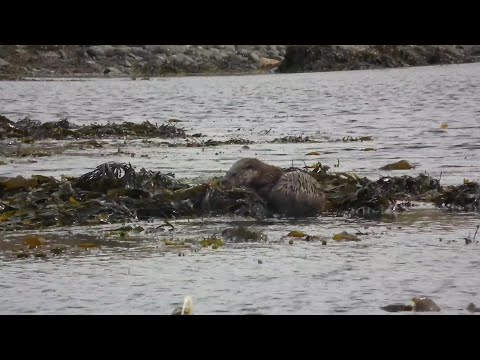
So, come and explore some of the wildest, most ancient and varied coasts and lochs in the world. There’s plenty of scope for adventure, wildlife and seeing the natural world from a different angle (ideally not upside down).

Connect and enjoy nature on the water
