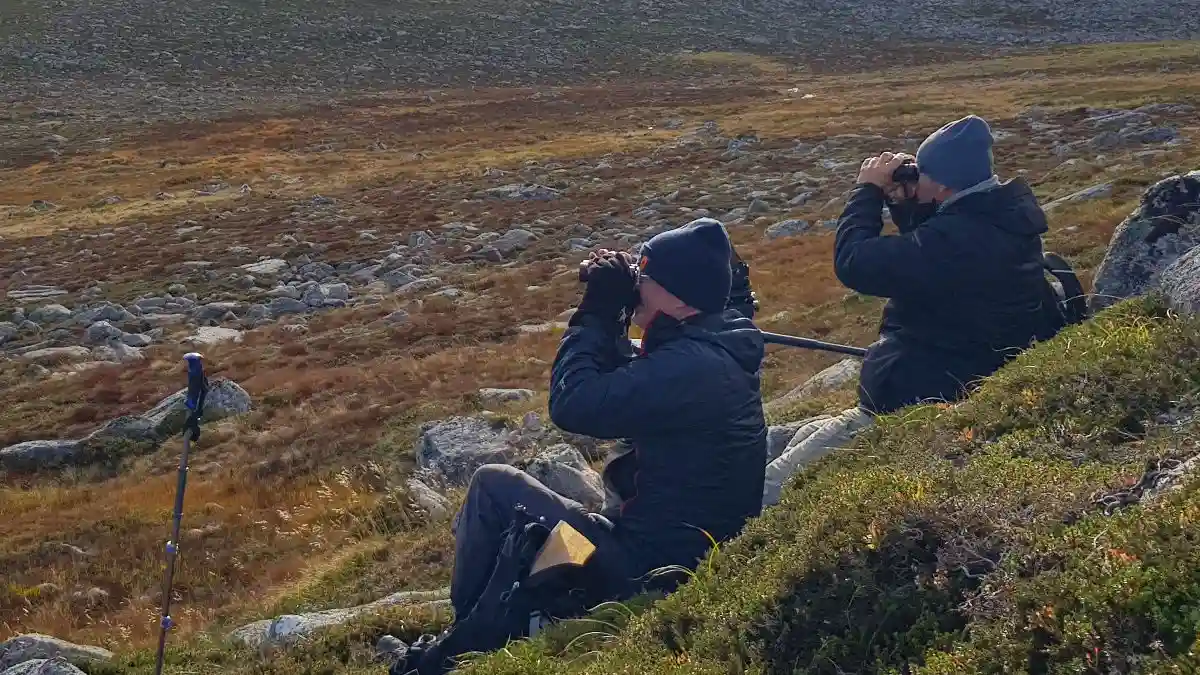
Correct identification of bird species depends on a variety of personal skills, equipment and environmental factors.
Birdwatching is a popular hobby, and identifying species is a rewarding challenge for beginners and experts alike. Here, learn more about the core skills involved in bird identification. To learn more about birding in the Scottish Highlands, read the post: Wildlife in Scotland: A Beginner’s Guide.
Go to
Using binoculars
Binoculars (or ‘binos’) are one of those essential items for bird identification. In fact, I often feel naked without them! Even a basic set of binoculars instantly enable us to observe a species in more detail than just by eye. They even make the difference between losing sight of the bird, or keeping it in view that bit longer. 8 x 42 binoculars usually give the brightest image. Check out the post on how to adjust binoculars.
Birding is essentially an outdoor hobby, so you will need to stay safe and comfortable. Check out these posts for advice on a birdwatching kit list and what to wear for bird watching.

Learn what are the common species
Knowing what are the common species in your area quickly helps you get to know those species better. Our brains are wonderful pattern-recognition machines and, through correct identification of common bird species, you get better at recognising those that are unfamiliar (this is good practise especially for novice birders).
Bird families
As your experience grows, you will quickly get to know the different bird families (to illustrate, check out the post What birds can you find in Scotland?). Within these are genuses, then species. So for example, the golden eagle is one of the ‘true’ Aquila eagles, within the raptor family. Each grouping has its own characteristics, which can help you narrow down your identification (see ‘Identifying to species level’ below).

Calls and songs: a secret to correct bird identification
Bird calls and songs can instantly help you identify a species – even if you can’t see it (yet). Although this might seem like a superpower just held by experts, beginner birdwatchers can (and should) begin learning bird calls and songs. Start by getting to really know those common everyday species and their most common calls. And remember calls and songs are not the same – different species use these in different situations.

Birdsong identifier apps
There are a great seleection of phone apps available now, which will identify bird calls and songs via your microphone. Usually you will need to record a video, or simply press the in-app button to activate the microphone and the algorithm will try to match the sounds to an online database. They are quite accurate no and, with increasing use of AI, are likely to get even more reliable. Some of us take great pride (and pleasure) in identifying bird songs and calls by ear alone, however!
🎶 Mimicry is common in some bird species. Thus, in some situations you may hear a certain bird’s call or song, but you know that bird isn’t present at that time of year. Or it just ‘doesn’t sound quite right’ for some reason. In fact, the call may have been incorporated into the song of a mimicking species. In Scotland, well-known bird mimics include starlings and song thrushes.
Use a telescope if possible
Whilst having a telescope certainly isnt vital to enjoy birding, it is definitely a huge plus! Telescopes give you a view that is simply impossible with most binoculars. Despite being a bit more bulky, expensive and awkward their ability to reveal unseen details and magnify distant birds transforms the viewing experience. My current scope is the excellent TSN-88 from Kowa.

Identification of ‘confusion’ bird species
‘Confusion species’ are those that closely resemble another. For example, the common buzzard is a classic confusion species for golden eagle here in the Scottish Highlands. So, when looking for eagles it helps to memorise the characteristics both of eagles and buzzards. What is a confusion species can depend on various factors, for example timing, location and sex or age of the bird. Intermediate-level birders have built up a good deal of experience, so they know what they might be looking at, even if they can’t yet make a firm ID.

Migratory and vagrant birds
Although knowing confusion species is very useful, the challenge with migratory ones is that they are simply not always present. Therefore, you may not be used to looking for them, or perhaps they are entirely unfamiliar. Obviously, this makes correct ID much harder. On the flip side, knowing what species are due arrive or depart can be a big help and even knowing specific ‘arrival dates’ can be extremely useful.

Range and visibility
The issues of range and visibility are always-present factors all us birders have to contend with. Observing at close range and in good weather conditions is an absolute pleasure, but it can carry risks for the bird. Examples of this include attracting predators, preventing adults feeding young, or interrupting normal foraging, resting or breeding.
Good visibility matters more for identifying some species than others. Waxwings, for instance, are so distinctive that they are almost unmistakeable even at long range and poor visibility. However, highly camouflaged species such as ptarmigan may only be visible at close range and/or in good visibility. An advanced-level birder knows how to maximise visibility of the species, by using various tips and tricks (for example, trying to view with the sun behind them to get a better impression of colour and size).
How visibility affects bird identification
Visibility depends on a wide range of factors, including:
- Time of day
- Time of year
- Rain, snow, mist
- Background (dark or light)
- Optical equipment (magnification, clarity, brightness)
- Your eyesight
- Wind
- Bird camouflage
- Habitat
- Lighting (backlit, in shadow, etc)
- Field of view

‘Species level’ bird identification?
When you can identify a particular species correctly, that’s called ‘identifying to species level’. But sometimes, for a variety of reasons, you might only be able identify it as a raptor, thrush, goose, etc. This can still be really useful, as it can help you eliminate what it wasn’t and therefore help you concentrate on what features to look for next time. On the other hand, some closely related bird species are almost indistinguishable from each other, even with good views. Usually, this is due to extremely minor differences in plumage or size and correct identification may only be possible by expert examination in the hand (for example, through mist netting). However, in a very few cases where interbreeding between species is likely, correct identification to species level is practically impossible. An excellent example of this in the Highlands of Scotland is the ‘Scottish’ crossbill.

Photos and video
Identification of bird species is becoming increasingly digital. Even an average photo can clinch an ID (in fact bird experts will often require a photo to corroborate records of rare species). Furthermore, video can capture the birds movements, calls or song. The problem, however, is usually around magnification. Many birds are seen at a distance, so you will need a decent zoom, image crop or a digiscoping setup. Thankfully, phone cameras are so good now that you can zoom or crop in to a huge degree without losing too much resolution. Compact high-zoom cameras are very effective here. Furthermore, recent improvements in AI and camera technology mean that certain apps can make a correct ID even through the lens (similar to ‘face recognition’).
⚠️ When taking photos, you risk causing illegal disturbance. It doesn’t always happen, but the risk is there – especially if you loiter in one spot for a long time, or move closer to capture the image. An important example of this is the capercaillie in Scotland.
Birds are one of the most widespread and varied groups of vertebrates (animals with backbones). This helps explain why birdwatching is one of the most popular forms of nature study. Follow these tips to take your bird identification to the next level!

Spring birding in the Cairngorms and more

Bird and wildlife watching rarely needs a high degree of fitness. Basic walking fitness will allow you to explore a variety of habitats on foot, whilst carrying your equipment. Exploring further afield, or facing more challenging conditions will require more stamina.
Not at all! A good tour will be tailored to your aims, experience and level of birding skills. You will get plenty of help to see whatever wildlife shows up.
The birding term ‘Jizz’ was used by World War 2 fighter pilots when identifying enemy aircraft. Properly, it is ‘GISS’ : general impression of size and shape.
A ‘twitch’ is any gathering of birders focused on seeing an exceptionally rare (often vagrant) bird species. For various reasons, not all birdwatchers enjoy ‘twitching’, and would not call themselves ‘twitchers’.